
Howard and Trish
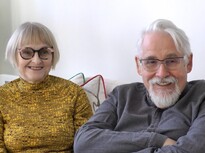
Howard is a professional musician and has been retired for two years. He walks daily with friends, which helps to improve his wellbeing. Howard and Trish have two adult children and a three-year-old granddaughter.
Howard, aged 73, was diagnosed with Alzheimer’s. He and his wife, Trish, live in a modern retirement village with good amenities and social events including opportunities to share music with others.
More about me...
Howard and Trish noticed that Howard was having memory problems and realised it was more than normal forgetfulness. Howard visited his GP and was referred to a dementia research clinic at the local hospital. After some tests, he was diagnosed with Mild Cognitive Impairment (MCI). Around five years later Howard had further assessments and was told he had Alzheimer’s. Since then, Trish and Howard have found out more about dementia and Trish attended several carers’ courses. The courses helped them to understand how they can both live well with dementia and make the most of Howard’s abilities.
Howard has never wanted to hide his diagnosis. He is open about his dementia and finds that others are understanding and supportive. It is important to Howard to be involved in groups and activities that are social and make connections with other people. He is a keen cook and understands the importance of a healthy diet.
Trish and Howard thought about the support they may need in the future. They updated their wills and appointed powers of attorney for both finance and health. After some consideration, Trish and Howard decided to downsize and move to a retirement village. They feel that the retirement village is a safe and comfortable place to live with facilities and social opportunities that really suit their lifestyle.
Howard jokes about busking in the supermarket.
Howard jokes about busking in the supermarket.
Trish: Well, I mean Howard a couple of weeks ago played the clarinet and piano middle part of Mozart’s concerto for his mum, so he can pick up the most extraordinarily complicated score, he doesn’t rehearse and he just plays it, and it brings tears to your eyes, and it’s, it’s perfect. I mean that’s what I find.
Howard: I have to practise occasionally, I can’t just do it straight like that.
Trish: Well, you very rarely practise.
Howard: But I’m willing to do that.
Yeah, that’s a gift isn’t it? I can’t, well I cannot imagine.
Trish: What, what I find extraordinary is that, you know, we’re having to write lists for Howard to go to Tesco and stuff like that and yet he can pick up a complex score and play it perfectly without even thinking.
Howard: Yeah.
Trish: It is, it is, the brain is a.
Howard: It certainly is.
Trish: Interesting.
Howard: Yeah, I tried it in Waitrose and it didn’t work [laughs] I got a couple of pence.
Howard knows the importance of daily exercise.
Howard knows the importance of daily exercise.
Trish: Again, I know, and we both know that physical exercise for dementia is very important; it’s very important what he, what Howard wants to eat and keeping alcohol low, if not at all. So therefore, since we’ve been in the retirement village we’ve found two couples that we particularly get on with and every morning [name], [name] and Howard go for a walk and they’ve all got the same pom-pom hats and it’s a bit like The Last of the Summer Wine. So, they go out for an hour’s walk every day and then they pop into the coffee shop downstairs and have a coffee, put the worlds to right and come back, so that’s, and your fitness level has improved actually.
Howard: Yeah, they put the world right because coz- [laughs] I just leave them to it and they just chat all of the time and eventually they ask me about bits and pieces.
Trish: As you say, they don’t have dementia.
Howard: But it doesn’t really matter.
So how, how long do you walk for, or does it depend on the weather, I suppose.
Howard: About two hours, I think, something like that. Or is it an hour and a half?
Trish: An hour, it’s usually, it’s usually.
Howard: The last thirty minutes is a coffee [laughs].
Right, right.
Trish: Yeah, yeah, he’s away for two hours but they actually walk usually around an hour/an hour and a quarter.
Howard: Yes.
Trish: And then you have your chinwag in the coffee shop downstairs.
Howard: Yeah, yeah.
Howard and Trish now live in a retirement village where Howard can get out and about.
Howard and Trish now live in a retirement village where Howard can get out and about.
Howard: What’s nice about it is the acceptance of it, and everybody knows in this place, they probably know that I have dementia but they’re not, they couldn’t care less, really. In a way they couldn’t care a damn and they just treat me as normal, and I can’t remember their names at all [laughs] occasionally I get them right, but it doesn’t matter.
Yeah. So, it’s a good community that you’ve, you’ve come to?
Howard: Yes.
Trish: Yeah, very much so.
Howard: Ooh absolutely, absolutely.
Trish: It, it’s the best thing we’ve ever, ever done and it’s something that went into the planning a few years ago. But in here, everybody’s in here for a reason probably, or well or just because they’re maybe getting old, they’re in their nineties. You can come in from age fifty-five. So, we have a twenty-four-hour concierge, everything, everybody is aware, the concierge, the staff know all our Christian names, it’s phenomenal, and everybody’s aware of who- that is the one criteria of anybody working here within the retirement village has to be, empathise with old, older people, and that definitely works. And we also have younger people, it’s open to all the community to come in, and lots and lots of young people use our Pizza Café and things like that, so we’re constantly mixing with young people. And Howard can wander off and go somewhere. If I was in our own home before-
Howard: I know where I am.
Trish: I’d be worried. I’d have been worried but I’m not here at all, I’m totally relaxed and that gives Howard independence as well.
Howard: So, I don’t, you know, I don’t get arrested [laughter]. It’d be, “Hi Howard.” “Yeah, alright?”
Making use of practical equipment helps Howard to cook safely.
Making use of practical equipment helps Howard to cook safely.
Trish: And cooking, Howard wants to do our cooking.
Howard: Yeah.
Trish: So that has changed somewhat in the last few years in the respect that I now buy Charlie Bingham and we now buy, you know, fillets of chicken that is covered in something or other. So, Howard can; you don’t mind me talking about this do you?
Howard: No.
Trish: Howard just switches on the oven and pops it in the oven and we put it on a timer. Originally timing was a challenge so I bought Alexa; so, we tell Alexa timing forty-five minutes. Howard hated Alexa. [Howard laughs] So what he’s now able to do is that he knows, you are aware how long something takes and he’ll check it properly [Howard laughs] because it did cause friction because things were going in the oven before the red light was off and it wasn’t being cooked properly.
But I, I also, I’ve also done things like we’ve had an induction hob installed because a tea towel was left on the other electric hob and it sort of burnt, so induction hob means that nobody can get burnt. And I’ve also had a Quooker tap put in because I’ve also, I’ve actually got arthritis, but lifting heavy kettles is a possible danger in the future; so, you’ve actually mastered that and you’re quite happy with that tap, aren’t you?
Howard: Mm.
Trish: So, it, it’s little things like that that you have to think into the future.
Howard: Into, yeah.
Trish: We don’t need it now but, in the future we don’t want tea towels left on the top of a hob and setting fire to something.
At a course run by Age UK, Trish learnt it was important for Howard to get on with tasks.
At a course run by Age UK, Trish learnt it was important for Howard to get on with tasks.
Trish: I think I learnt from the course that Howard had to do, had to, it sounds weird this word ‘allow’ I had to allow Howard to do whatever he want, whatever he could and wanted to do and I must not interfere. So, Howard does our recycling in an interesting way, so, but, you know, he’s doing it full stop.
So we are, this is how we deal with it and I a hundred percent know, as Howard does, and he keeps staying active, he has to remain active and keep using your head and he’s doing that successfully; how long the disease will take, you know, we don’t know, but.
Howard: Keep the washing up going.
Trish: But he’s doing as much as he possibly can for him.
Howard: Routine, routine and keeping, keeping busy.
Trish: You do a lot really.
Howard: I know.
Trish: I think you do.
Howard: Yeah, I want to, I want to.
Trish: I’m very happy that you vacuum, I have no problem with that. [Interviewer laughs].
Howard: Oh that, yeah, yeah.
Yeah, yeah, yeah.
Howard: Well I.
Trish: Or do the, or do the recycling in a bizarre way.
Howard: Yeah, well, well as I said I, I’ve got, yeah, I don’t mind anymore; for the life of me I can’t do the…
Trish: Because I used to do all the recycling stuff before.
Howard: No, I can’t do, I can’t do [laughs] eh?
Trish: You can’t do what?
Howard: The dryer, the tumble dryer and all of that, I don’t know what I’m doing as far as that’s concerned.
Trish attended a course with Age UK where she found out about their entitlements.
Trish attended a course with Age UK where she found out about their entitlements.
Again, from that course that I did with Age UK I discovered you could have attendance allowance, I discovered that if you have attendance allowance and you have a memory problem you can actually get twenty-five percent off your council tax, you know, all that type of stuff you have to find out, and it may say, may, may sound trivial but, you know, when you need carers or when you need support later on then that money is going to be quite useful.
The smart speaker was no good for Howard.
The smart speaker was no good for Howard.
You raised your eyebrows when Alexa was mentioned, do you use Alexa?
Howard: No.
Trish: I had to change Alexa’s name to a man, he hated it.
OK [laughs] Some people find Alexa quite helpful and others don’t, I know. [laughs]
Trish: I daresay in the future it may come back into its own, do, do you know what I mean, it might do, but at the moment.
Howard: No.
Trish: So she’s off.
So, OK, OK.
Howard: You’re bad enough and without her [laughs].
It’s important to Howard to get on with life.
It’s important to Howard to get on with life.
Have you thought about sort of the future, how, what you might like to do if you do need extra support, care, whatever?
I haven’t thought about that at all. It is, it is funny actually you’ve got to do, I reckon that, that I’ve decided to accept and work with it, because nobody else is going to work with it for me, you know, so [clears throat] I keep on going.
But it’s, it’s not as if, I’m sort of not waiting for anything, this is it; so I’ve, I’ve just got to make what I can of it now and the future. So, I don’t want it, I think it’s important that I actually stay doing things, working at it, even if it’s just not a lot, but.
Trish explains that Alzheimer’s is one type of dementia.
Trish explains that Alzheimer’s is one type of dementia.
It was, but also at that stage she said to me, “Well Howard has Alzheimer’s.” And I said, “Well I thought he had dementia.” She said, “Well he has, he’s got Alzheimer’s.” But you see – we, I didn’t understand, I now understand dementia is the umbrella name, as cancer is, and the type of dementia Howard has is Alzheimer’s, so, and we’re reasonably intelligent people but I had not twigged to that and nobody, you know, nobody actually sort of explained to me, and I now know there’s like ninety to a hundred different types of dementia.