
Jennifer
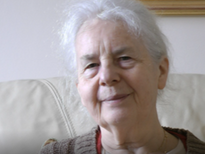
Jennifer and her husband purchased a property in a retirement village that could offer ongoing nursing or specialist dementia care. Jennifer feels secure and has the freedom to live life as she chooses. She can arrange extra care as and when she needs.
Jennifer, aged 74, is a retired GP and has lived in a retirement village for nine years. She is widowed and has three children who live in various countries around the world. Jennifer lives with dementia and has written a book about her experiences.
More about me...
Jennifer noticed early signs of dementia in her late fifties and retired from her role as a GP. She was diagnosed with mixed dementia and also has a heart condition. Living in a retirement village means that Jennifer has the security of knowing care teams are on hand day and night. She has daily help to check on her when she gets confused and to manage her medication. The care teams are employed and trained by the village so whenever Jennifer needs extra help it can be quickly arranged.
She and her husband chose this place because it offered independence but also provides all the care she may need to end of life. Should Jennifer need additional care in the future there is an option to sell her apartment and move into the specialised advanced Dementia unit in the retirement village where she can enjoy the same facilities and see familiar friends and staff.
Jennifer believes it is important for older people to maintain their independence and remain enabled with support where needed. When choosing a retirement or care home, Jennifer thinks people should consider whether it will serve their needs long-term or, alternatively, would they be prepared to make a second move if needed.
In addition to the capital outlay of purchasing the apartment, Jennifer pays a monthly fee. This covers her care package, a contribution to the maintenance of the village and use of the facilities, including a swimming pool and gym. The cost of care is paid from her income which includes pensions, attendance allowance and returns on investments from the proceeds of selling the family home.
Jennifer talks about attendance allowance.
Jennifer talks about attendance allowance.
Yes, well I do get, you know, some attendance allowance, which you can get because I need care, and there are people who don’t know that; I’m surprised the number of people who don’t know that it’s available; and you have to claim it, you know, you’re not offered these things [laughs] so you have to be willing to accept and it’s why not, you know, I’ve worked all my life [laughs] and paid for it and it, it’s there for those that, that want it. So, people should be willing to accept what they need.
I Keep thinking “how, how would you know?” It’s just one of those things.
You’re often not told, and there are allowances, I mean, even if you live by yourself in a flat, you know, you get reduction on your council tax, for example. A lot of people don’t know that even.
No
So, particularly if they’re, you know, getting elderly and they are confused and so on. And often if you are elderly, you can get help with other things, you know, with your electricity or your gas and all that kind of thing and – but we have someone from the Citizens’ Advice Bureau that comes once a month, I think, that people can talk to.
Jennifer recognises that technology and robots may become part of delivering social care.
Jennifer recognises that technology and robots may become part of delivering social care.
Well the difficulty is, is that as people get older, you know, we’re living longer, it’s true, so disability is not increasing, it’s just that it appears to be because people live longer with it [laughs] and there aren’t enough carers around and I think that, you know, the care profession has got to be almost re-evaluated, it’s not, you know, if someone says they’re a carer they’re considered not to be as good as if they’re a teacher and I think that has got to be, that’s got to change because there aren’t enough people to provide care, there aren’t. It’s nothing to do with pay; I mean pay comes into it, of course, but there aren’t enough people. I mean when I was at school one in two females went into nursing, for example; they certainly don’t now. So, I think the day of robots is going to come, not to provide the human touch, the human responsibility, the human care, but I do think robots are going to be used, I do, and why not? You know, to ask you have you taken your medication [laughs] or provide, deliver your meals or whatever, but you, it’s not going to replace the human touch because nothing can, a robot can’t replace that, the human relationship, but I think we’re going to have to accept robots, and a lot of older people aren’t prepared to do that.
Jennifer says you have to ask for dementia support and she lists places to go for information.
Jennifer says you have to ask for dementia support and she lists places to go for information.
So, is there, what would you say, in a nutshell, if people are starting to look for care, they expect to have to fund their own care, what, what would you say they should do, where do they start?
[Laughs].
Big question.
It is a big question. We looked on the internet, you can ask locally, you can ask your GP, though some GPs don’t have a clue, others do [laughs] you can put it into the internet with, you know, care of the particular type that you want. Again, I would try the Citizens’ Advice Bureau or community centres or libraries. I mean some libraries are really very, very good; I mean our local library, again it depends who’s on, but, you know, they told me about the bus pass, free bus pass and they told me about all kinds of things which I didn’t know about; so, they can be good. But again, we have to ask.
But I don’t think we can expect the GPs to do it, they’re up to their eyes, but I know there have been times when; I mean I know the Alzheimer’s Society, I know that they have offered to do things, but it depends on your, your area again; so, it comes back to the postcode lottery, which isn’t fair. It would be wonderful if there was one kind of hub, you know [laughs] one resource that was available to all GP practices, because it would be a wonderful way of handing it out, because that’s where everybody goes, isn’t it, at some stage?
Jennifer says she wanted a care facility that would serve her changing needs until the end of her life.
Jennifer says she wanted a care facility that would serve her changing needs until the end of her life.
We looked at dozens of places all-round the country. Well having been a doctor I had, of course, great experience in my local care homes, and residential care homes. I wanted independent living; that was my most important thing; but also, somewhere where I could stay till I died. I didn’t want to have to be moved and so many places you could only live there until you reached a certain level of incapacity and that was not what I wanted; you make friends, you get to know the staff; and in this place the staff in a sense rotate round; we’ve got the main village and then we’ve got a nursing home and we’ve got a more advanced dementia unit, well not just dementia, where people need twenty-four one-to-one care. But the same kind of staff so you get to know them and you get to know the people and having been here so long of course I know people in all these different sections and we kind of mix, I can visit anywhere, which is lovely.