
Sir Terry Pratchett
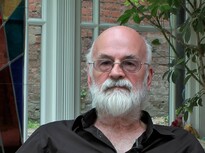
After some false diagnoses, Terry was diagnosed in 2007 with a rare form of early-onset dementia called Posterior Cortical Atrophy, known as PCA. He started having problems reading and writing. Terry published several novels after his diagnosis which he created by dictating to his assistant. In 2014 he reluctantly cancelled engagements and stopped creative writing later that year. Terry died in March 2015.
Sir Terry Pratchett was a best-selling author, known for his humour, satire and fantasy novels. He wrote stories and articles for his school magazine. When he left school, he trained as a journalist with the local paper. This conversation was recorded in July 2010 when Terry (then aged 62) gave an interview with Oxford researchers to help people understand life with dementia.
More about me...
Initially, Terry was devastated. He cancelled work appointments but then realised that he was doing OK so decided to carry on with his writing and attending conventions.
Terry felt fortunate that his success as an author meant that he could afford to pay helpers. Although this eased some things, it could not change the diagnosis or stop the decline.
He appeared in television documentaries about living with dementia. Terry firmly believed in the right to assisted death for people with terminal illness.
Terry explained that his problems were immediate rather than forgetfulness. And was amazed how he could remember details of jokes and songs from decades ago.
Attending a meeting of people living with PCA, Terry found it reassuring that others understood what it was like. He did not feel that he was a person who usually benefitted from groups and said that resources like this website would be a great help to people to hear about others going through the same experiences.
Terry would like to be remembered as ‘a guy who wrote some books that didn’t do much harm, not the author who died with Alzheimer’s.’
Terry Pratchett discusses making advance decisions.
Terry Pratchett discusses making advance decisions.
That that is why I want to, I want to, as it were, leave a living will, which says that when I am, effectively, in a vegetable state then please quietly let me just drift away in my sleep my sleep. Whereupon somebody anti said, “Oh, well, you see it’s well-known people’s personality with Alzheimer’s changes and so you can’t make that decision even in the future because that won’t be you.” And I thought, “Ah, typical thinking. That means I cannot actually leave a will.”
Because the person that dies won’t be the person that makes the will but the, what I am saying is Terry Pratchett, compos mentis, should make the rules, you know, I should be my own best friend in that one.
Terry found he had to work harder to remember things.
Terry found he had to work harder to remember things.
Most of the other, there aren’t many other problems except the perennial leaving the keys somewhere, which is I suppose everybody’s problem. But for me it’s, you know, I can put the keys down and forget where the keys are in the same movement. It’s not a case of, but again, one learns things, voices are good. If I say, “I’ve put my keys on the side of the desk.” I will later remember me saying that.
I have to kind of work, and that’s really, I assume this is the same for people with, what you might call ordinary Alzheimer’s. You have to work at things once upon a time you didn’t have to think about. like going to public toilets. These days there’s, normally, several doors you have to go through even before you’re gonna get to the place where, as it were, you’re going to perform and then, there will probably be a kind of area with several different, seven different… see, PCA is just happening. The word has dropped out. You’ll go through this door and there’s a door to, there’s the door to the ladies, there’s the door with the fire extinguisher stuff in it and there’s the there’s the door for all the stuff that the janitor uses. And you’ve gone through several doors and you can’t remember how to get out [laughs].
Because there is no obvious way and I had a mnemonic for making certain that I never go into the ladies toilet, which is always go into the one that shows the lady with the slacks. Never go into the one with the Scotsman in the kilt. And so, this is so ridiculous that it works. Because it stops and makes me think and actually, for the person the person with PCA, life is a series of make shift arrangements.
I think you described it as work around somewhere.
Work around, yes. My life is a work around. We work around life.
Terry found it helpful to know there are other people ‘in the same boat’.
Terry found it helpful to know there are other people ‘in the same boat’.
You mentioned earlier that you’d gone along to some support groups?
Yes.
And are you still doing that?
Well, I needed I keep thinking that sometimes I should go up there and I’ve sort of been in contact, occasionally, with other people there. And I keep thinking, yeah, next time we’re in London. Well, I don’t think they have them that often. I think it’s about twice a year and I’m kind of vaguely allergic to London, as most people are that live in the country. It was very helpful. I haven’t gone back to another one because, oddly enough, all I needed, it seemed to me, that big dose of “there’s other people in the same boat and I’m going the same way” you know. There was one, I don’t know if she was a school mistress but in every respect she appeared to be a school mistress, who had to have someone to help her dress every day. I don’t.
After diagnosis, Terry cancelled plans but then realised there was a lot to look forward to.
After diagnosis, Terry cancelled plans but then realised there was a lot to look forward to.
I didn’t exactly panic but I thought, “This is it.” You know, I was cancelling all kinds of engagements and quite important things and completely changing my life and then it suddenly dawned on me that not an awful lot was happening. It had been happening beforehand, the reason I was going to the doctor.
And then a lot of the problems you can get round by just a subtle rearrangement of your life. I would say, first of all, don’t despair unless you particularly wish to despair and anyway, it’s your choice but if you’ve been diagnosed early, and I hope I really hope that you have been diagnosed early, there’s plenty to look forward to.
Having PCA made Terry’s diagnosis tricky.
Having PCA made Terry’s diagnosis tricky.
I have PCA anyway, which is the same pathology as Alzheimer’s but begins in a in a different part of the brain and it is harder to get diagnosed because it isn’t, if you like, a common or garden or vanilla Alzheimer’s. In fact, there are several varieties. And I actually, was once told that I hadn’t got Alzheimer’s, after a scan, because they weren’t looking in a tiny little corner, where they, the PCA was, was hiding, which was a bit of a blow at that point.
Terry describes his dementia as an embuggerance.
Terry describes his dementia as an embuggerance.
It’s very hard to explain what it feels like to have this. It’s like wearing the mental equivalent of a fat suit. It ages you. I feel myself doddering and at sixty-two you are a bit too young, we believe, to dodder.
You called it an encumbrance in I thought?
I called it an embuggerance.
Embuggerance [laughs].
Yes [laughs]. Well, a bloody nuisance. It’s a it’s a sort of a military term for an absolute bloody nuisance that we can’t do anything about and it does but you it does encumber you. As I said, the mental, the mental equivalent of a fat suit and the curious thing, especially if you’ve got PCA, it doesn’t really show up that much because, as they always say, cunning is the last thing to go and people say, “But you’re chatting away and you’re breaking into song.” And doing all the other stuff that I do and I said, “Look, no.” And I said, “Well, yeah.” And people with Alzheimer’s can do that. I mean things get worse and we know that there’s an end game but, but life does not stop and, in some ways, and I the last, I would be the last person to say that there’s a good side of getting it.
Memories from long ago are clear for Terry.
Memories from long ago are clear for Terry.
But, on the other hand, I have quite a treacherous memory so I can remember, if you remember earlier today, I was singing to you, bits of the Private Eye vinyl records that were around in the nineteen sixties [laughs]. Heaven knows how this ragged brain has managed to – I’ve got one brain cell marked “Private Eye scurrilous songs about Sir Edward Heath”. How, how does the memory work? Why am I wasting, you know, why I can remember all kinds of bad books and terrible movies. If only that, those brain cells could be employed elsewhere.
PCA affects Terry’s vision and spatial awareness.
PCA affects Terry’s vision and spatial awareness.
What is PCA exactly?
Well, I can only define it by its effects, which is really how you can.
As I said, it makes you clumsy. It, it’s visual Alzheimer’s, visual and spatial Alzheimer’s
It’s seeing things. I can look at a table and not see the candelabra on it.
And then I’ll, someone will say, “The candelabra is on the table.” I’ll look at it but look at it, and there it is. The brain doesn’t do that bit.
I see.
And it’s very weird. It’s like playing hunt the slipper by yourself.
It wasn’t just, if you told me to pick up something on the table I would go to the table and pick it up but if I was looking for it in a hurry, I might not see it was there.
Quite likely might not see it was there because at that particular point one of the little random ball bearings that is bouncing around in the bagatelle board of my head has just flipped out of the socket.