
Maxine
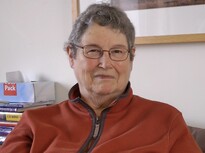
Maxine, aged 74, has a diagnosis of Alzheimer’s. Her medication is Rivastigmine patches worn on the skin. She visited her GP when she noticed increasing difficulties finding words and organising her thoughts. Maxine says it is important to get an early diagnosis.
Maxine is a writer and editor who retired aged 73. She worked as a psychotherapist for almost 30 years. Maxine has many interests including ecology, gardening and art; she writes poetry and a blog about experiences of dementia. Maxine is white-British.
More about me...
When Maxine had concerns about her cognition, she looked into which consultant neurologist she wanted to see. She had some health insurance which enabled her to have a consultation. She asked her GP to refer her and found the process quite supportive. After assessment, Maxine was told that she had some cognitive impairment but they could not give a clear diagnosis. If she wanted to be certain, she would need a Positron Emission Tomography (PET) scan, which would have to be paid for. She feels fortunate that a member of her family offered to pay for that so she got her diagnosis quite quickly.
It took time to get the balance of her medication right and Maxine continues to have this reviewed. The medication is in the form of patches. Although she has had a few side-effects, such as irritation on her skin and occasional headaches, Maxine feels that the medication is working and her thinking and concentration has improved.
Maxine received her diagnosis of Alzheimer’s disease by email. Although this might seem insensitive, Maxine says it meant she had time to take in the information so that when she saw the neurologist a few weeks later she felt more prepared and could ask important questions. Maxine then spent time organising a Lasting Power of Attorney and Advanced Decision for her future care.
Technology is something Maxine makes good use of. She uses Alexa, a voice-controlled device, which assists with reminders for daily tasks, appointments and medication. The device can also control electric sockets so that Maxine can make sure things are switched off and safe at night.
As well as writing her blog and poetry, Maxine loves to read. She also spends time on other creative projects including textile art and knitting and has a strong interest in ecology. Maxine is a member of an ecology book club and plans her garden around these interests.
Maxine is a member of a book club that specialises in ecology.
Maxine is a member of a book club that specialises in ecology.
Well, I mean I do things like knitting, I make textile, kind of textile art; you could say those are hobbies, I think they’re, they’re creative projects; not that I’m saying they’re wonderful, I’m wonderful at them, but. And it’s like my writing, my writing is very much part of who I am, it’s not a hobby [laughs] you know, it’s not what I do when I’m not doing something else, it’s actually part of who I am. So, I do all I do that. I’m very interested in ecology and I do quite a lot of reading around that; I’m in an ecology book club and I’m just transitioning my garden into a forest permaculture garden, with a lot of help from other people.
Maxine is going to use her allowance to pay for cleaning services.
Maxine is going to use her allowance to pay for cleaning services.
Would you like to tell me about how you’ve planned for any kind of care you might need either in your home or elsewhere.
Well, I don’t know as yet. At the moment I do, I’ve just heard that I’ve got attendance allowance. But that doesn’t necessarily mean that I’ll have a carer as such. I’m going to have the house cleaned, regularly and I’m going to do things which make life more pleasant, easier, and so that I can get on with the things that matter to me. So, when it comes to wanting care, I’ll deal with that when it happens.
Maxine thinks it’s better to make an advance decision than be worrying about her future.
Maxine thinks it’s better to make an advance decision than be worrying about her future.
Have you not come across advance directives before?
I don’t know the process of it.
Right, and it is a legal document. It is witnessed and so it does have that kind of weight with it I suppose. And I’ve chosen to do that rather than having the caring lasting power of attorney. Because they can conflict slightly. And basically, one of the things I want is, I don’t want my daughter to have to make that decision on my behalf. I want her to be able to go in and say, “this is what my mother wanted, even if she can’t say it” not to feel that she was put in a position where she had to make the decision. I was in that position with my mother and it was not comfortable. And, yeah, so I feel that just sort of makes things clear and it’s as I want it to be.
I think a lot of people, they might think about those things but and have a preference, of course, but I think it’s such a- it’s quite big step to take to actually have that discussion and make, actually put it out there, isn’t it?
Well, I don’t feel it is particularly because for me it’s, if I don’t talk about it then I’d just be worrying about it. “When I am I going to tell people?” “What happens if something goes wrong?” I don’t know how long I’ve got, I may have, according to the neurologist, up to ten years, so, I’ve never planned for ten years in my life. So [laughs] I think that doesn’t impact on me that much. So, to me, it would be harder to keep quiet about it and be constantly be worrying that I. I think I did say to my daughter once, I’m worried that if I’m taken into hospital if there’s an incident of some kind that they won’t have the documents that show what I want. And she said, “Mum, I shall be there” and that’s all I really needed.
Maxine explains how to write an advance decision.
Maxine explains how to write an advance decision.
Well, you don’t need to see anyone for the advance decision. I needed to do it, and I did it through a charity called Compassion in Dying, and they have an online template that you can just follow through and decide what you want on it or you’re completely free whatever you do on it. But it covers the bases that could be quite difficult to think about especially when you’re thinking for the future, in a way.
And so I found that very helpful and then writing a statement also. Which, I tend to think of it in terms of well, the advanced directive is about what you don’t want to happen and the advanced statement is about what you do want to happen. And then the lasting power of attornment, attorney is about who will support you in that happening. And that feels to me like a, a great package. It solves all sorts of problems.
So, did you discuss, you know, you got the template and you were working through that, did you discuss that with anyone along the way?
As far as I’m concerned, it’s my decision. I don’t have a partner, I have a daughter and I talked it through with her but she was very clear that whatever I wanted was, she knows me quite well, that whatever I wanted was what she would support.
It was important to Maxine to get an early diagnosis so that she could make arrangements for her future.
It was important to Maxine to get an early diagnosis so that she could make arrangements for her future.
I, well the first thing was that I wanted an early diagnosis, that was most- starting point. Because I didn’t want to be told “go away for a year and we’ll see what happens”. And that, I know people who it’s taken three, four years and I think those are three or four years lost that could be used helpfully. So that was the first priority for me, and then, the other thing was that I wanted to make choices about the future before I got to the point when I couldn’t make those choices.
Yes, yes.
So, that was very clear to me what I wanted, and what I’ve always felt is that I didn’t want to go on living up to a point where I’m not actually aware. so, I did spend, after I got the diagnosis, I spent quite a few weeks just going through, making an advanced decision and writing my statement and getting Lasting Power of Attorney sorted out [cough] and I found that enormously liberating.
Maxine says using technology helps her maintain her independence.
Maxine says using technology helps her maintain her independence.
But I did hear someone on the radio saying, “That’s dreadful that people need things like that to, you know, that, that, that, using technology to manage their lives because they’ve got dementia and they ought to have people caring for them.” I don’t want people coming in and; I, I, it’s not that I don’t like people but I want to have my relationships with my friends and family and I don’t want them to be, you know, if there’s a way of making them not based on being cared for then I’ll do that because it’s more fulfilling.
Learning new skills with dementia is possible, says Maxine.
Learning new skills with dementia is possible, says Maxine.
That’s great. How did you find out about things like that though?
Well, I’m a bit techy, as you might have [laughs] I’ve always been a bit techy; I’ve used computers for a very long time and, and I’m not, I’m not frightened of them. There are things that I can’t do, there are things that I wouldn’t try and do now that I might have tried to do before, but I think, certainly someone was saying people think that people with dementia can’t learn and it’s not true at all. I mean, OK, at a certain stage, yes, that might be very difficult and I’m aware that because of the people I’ve known that there’ll be a time when I can’t actually use a phone or I can’t use a computer – but then the longer you’ve used it then the longer you’re likely to retain that. Again, so that’s another reason why right now I’m putting into place things which I think will stay with me, because I’ll have had them for a while before things get worse, hopefully, we’ll see.
Safety measures like smart plugs help Maxine manage in the house.
Safety measures like smart plugs help Maxine manage in the house.
Yeah, yeah. So, so that’s, that’s important; I’ve got three of them all round the house and so; and actually I’ve got things, I’ve got smart stuff to turn off electricity at night and things like that now.
Oh just tell me about that then.
Well I’ve got two smart plugs which are plugged into the television and/or my computer stuff and everything else, and they just are timed with Alexa to turn off overnight and then turn on again in the morning or, or I can just say I want them to turn on or off and they will, they’ll do it. And it, to me it’s just, it’s, it’s obvious, you know [laughs] it just helps.
Maxine uses her smart speaker to remind her of important tasks and appointments.
Maxine uses her smart speaker to remind her of important tasks and appointments.
And the other thing is my Alexa, who will probably wake up now, but every morning I put everything in my diary into reminders on the, on her, and so I’m told when to get ready to go out or when there’s going to be a phone call or a Zoom or whatever – I know that before it happens
Oh OK
And the regular things like taking tablets and things are all in there as well. So, I think that’s great.
Oh, OK so that’s all on the, sort of an App that goes through Alexa and it, and that brings, brings up your reminders.
Yeah, yeah and I don’t, I don’t put my calendar online, I’ve always had a paper calendar and a paper diary and I wish I could do it the other way round because it then would tell me every time there was something in my diary, and I’ve tried it but I haven’t quite managed to transition onto that.
Right, yes.
So, I’m finding that really helpful; and again, it’s because it frees me up from worrying or missing things that are important, it frees me up completely that, from that because it’s all – there and I…
Yeah, yeah. You can rely on Alexa.
Absolutely, she’s great; she’ll even tell me a joke if I need one, so [laughs].
Maxine explains about her medication and how it helps.
Maxine explains about her medication and how it helps.
So, can you tell me a little bit about the medication that you are on then? Because obviously that is a different, different to having tablets.
Yes. I think there are, I think there is one other make of patch but his take on it is that, yes, fewer side effects, and more effective because it’s not going through the digestive system. And it’s 24-hour patches which is a bit of a hassle because I go to aqua-aerobics and they tend to loosen in the water and things like that but, you know, it’s yeah. So, it, I mean obviously, it’s doing the same as most of the medications are doing. It’s not solving the problem, it’s not curing it, but it’s making the brain cells work, that are working, work better. And I think it’s making connections easier and my brain feels better organised than it felt when I first realised what was going on. I feel much better than I did.
Oh, that’s really good then, isn’t it?
Yeah, yeah.
So, there’s a, there’s been a positive result from having the medication?
Definitely. Definitely. I think I’ve found it, for quite a long time I’ve found it quite hard to have a conversation like this. I would have got a bit lost.
One problem for Maxine is that the adhesive on the medication patches irritates her skin.
One problem for Maxine is that the adhesive on the medication patches irritates her skin.
I’m now getting used to being on patches and the things that do, do cause a problem that; and, and of course now I’m on stronger ones then they’re, those are slightly changed, so. But the message I’ve had, and I know; see my doctors’ surgery don’t prescribe these, they’re, they are available on the NHS but they can’t advise me how to use them because they don’t prescribe them; I have to do it through the neurologist. I don’t know why that is; they’re, they’re not experimental, they’ve been around for many years. So, I don’t know whether it’s cost or whatever it is, but if it was something urgent, I would be able to get in touch. And when I started being a bit allergic and I was getting, I was getting, I still do get pink circles where they’ve been, but I was a bit alarmed, and then I know I can ask about it and some, and he will know, he, he told me exactly what to do.
Oh right.
And, and it’s much better than it was. But his take on it is that if I can possibly cope with them; I get some kind of migrainey headaches, which is supposed to be one of the side effects that could, could be happening, but his take is that if I, there’s nothing damaging about any of that and if I can cope on them, it’s the best thing for me. So, I’ve got a lot of motivation to carry on and, and live with it [laughs].
Is, and were there any other side effects of having those then?
Those, those are the only two that I’ve had, just these, these occasional; they’re not bad migraines, they’re just a slightly migrainey headache, and the stickiness [laughs] which is a bit better than it was [laughs].
After a few days, Maxine had come to terms with her diagnosis.
After a few days, Maxine had come to terms with her diagnosis.
So, the PET scan happened and the neurologist went away on holiday which was very inconvenient of him [laughs]. But eventually, I rang the hospital and said “can I find out the result” and they actually emailed me and said, “you’ve got Alzheimer’s” [laughs]. And some people might say that’s a dreadful thing to do, but actually for me, given who I am, and what my approach to this is, it was absolutely fine because by the time I saw him, which was a week or so later, I had time to process it.
There was a bit of a shock for me, there was a sort of physical feeling of shock. But within a couple of days that had gone and I’d already started processing on from there and beginning to know what I wanted, how I wanted to deal with it and so I could have a much more useful conversation with him when I saw him again.
Yeah, that’s interesting, isn’t it?
Whereas probably if I’d been in the shock I would have, you know, it would have just all come from there, and, yeah.
Yeah, I’m sure- yes, that’s, that’s true actually about any diagnosis, I think. You, sort of, just reeling from the words they’ve said…[cough]
Yes [nodding]. Yes.
And it’s difficult to have a sensible conversation and ask the questions that you would if you have a few days to think about it.
Yeah. And, and I wasn’t panicking, you know, I wasn’t, and I know, I know it makes lots of people panic and I know it can be absolutely awful but that wasn’t how I was feeling. I’m not saying that I’m better or, you know, anything else, than anybody else but I was very, I felt very fortunate to be able to do what I was doing which was to get this definitive diagnosis because, you know, I could, he could show me, he showed me it so there was no, there’s no moving away from that.
Maxine feels fortunate that her diagnosis was quite quick.
Maxine feels fortunate that her diagnosis was quite quick.
So, what, who did you see first then?
Well, I knew I’d got, I had a, because I was self-employed mostly, I had an insurance policy for my health, which I hadn’t quite given up yet, and I had one free appointment with a consultant as part of that. So, I found the person I wanted to see and then I saw my GP because I needed GP referral. And my GP was very supportive of me doing it. It was somebody I hadn’t met before but she was, you know, behind it, and so referred me on. So, one of the things about my process through it is that it’s been very quick, I think, compared with most people’s.
Ok so how long ago was it that you started that process?
It was about nine months ago. So, it took about six months for me to get the diagnosis. But I’m very aware that it’s not always like that. And I also felt so strongly that if I had it, I really wanted to know and I wanted to do something and that was, that was so important to me. I wasn’t in a position where I was saying “no, I don’t want to look at this” I was really up for it.
Having a PET scan would give Maxine a more accurate diagnosis.
Having a PET scan would give Maxine a more accurate diagnosis.
I hadn’t yet told anybody. I’d told my daughter that I was looking into it a bit but she didn’t at that stage come with me. I just, because I thought I might be making it up. I thought it, you know, there was always an outside chance that people do occasionally drop a remote control, without any awareness, in a bowl of water. You know, [laughs] there was, you know, I wasn’t so sure so, so at that stage I didn’t say anything. And he did, you know, the usual memory test, which of course I pass 100% every time and lots of people do who’ve got, you know, who are reasonably OK and intelligent and so on. I think it’s a rubbish test [laughs] to be honest. And he said “well there is some cognitive impairment” and there’s only, there’s, the statistics showed that it was about a 50-50 chance, either that it was just Mild Cognitive Impairment, as I get older or it could be dementia and Alzheimer’s probably and the only way to find out was to have a PET scan.
Losing her independence or moving to a care home would be difficult for Maxine.
Losing her independence or moving to a care home would be difficult for Maxine.
I don’t want to, I can’t claim any insight into the future but, you know, certainly if it happens as I want it to. I don’t mind be looked after, that’s not really a problem. I do mind institutions a bit and erm, and I mind how people with dementia are treated, a lot. And so, you know, there are things that losing my independence would, could involve that I’m not really prepared for, if I can avoid it.
For Maxine it was more than struggling to find words.
For Maxine it was more than struggling to find words.
Well, I suppose it goes back to me having been – I have a very close friend who died with dementia during lockdown. So, I’ve been very close to someone who had been going through the whole process. And, so I probably was more aware than I might have been. And, and I also had quite strong feelings about what I wanted to do if it ever happened to me. So, there was one event that happened, actually there’s a poem about it on my blog, where I went in the kitchen and found the TV remote control in the sink with water in it. And that was enough to make me think “hang on, I need to look at this”. Because I’d been losing words, like most people do and there’s a thing that people my age do where you go round and you say “oh I’ve forgotten that” or “I’ve lost that word” and the other person says “oh I’m always doing that” [laughs].
True, yes.
I’ve done it myself. And you know, I’d got beyond that sort of place. So, that’s what made me decide to go. It was just like the whole thing switched on and I decided what to do and took it from there.
And I’ve found that I’m, I find organising things much harder. So, to me, it’s not about memory on its own, at all. It’s, it’s about how we structure and organise the thoughts and I was really struggling to motivate myself to do anything and, and to and to manage doing anything. This was one of the reasons why a cleaner because I just wasn’t able to do it. I had no idea why, I just couldn’t.
A PET scan showed Maxine had early Alzheimer’s disease.
A PET scan showed Maxine had early Alzheimer’s disease.
And he said “well there is some cognitive impairment” and there’s only, there’s, the statistics showed that it was about a 50-50 chance, either that it was just Mild Cognitive Impairment, as I get older or it could be dementia and Alzheimer’s probably and the only way to find out was to have a PET scan.
So, the PET scan happened and the neurologist went away on holiday which was very inconvenient of him [laughs]. But eventually, I rang the hospital and said “can I find out the result” and they actually emailed me and said, “you’ve got Alzheimer’s” [laughs]. And some people might say that’s a dreadful thing to do, but actually for me, given who I am, and what my approach to this is, it was absolutely fine because by the time I saw him, which was a week or so later, I had time to process it.