
John
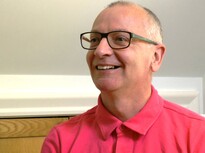
John has years of experience supporting LGBTQ+ people living with dementia. He previously worked for the LGBT Switchboard and now, alongside his work for the LGBTQ+ Dementia Advisory Group, is studying for a PhD.
John is a director of LGBTQ+ Dementia Advisory Group, a community interest company. His work involves supporting LGBTQ+ people living with dementia and raising awareness of their needs by delivering training to health and social care professionals.
More about me...
Chosen family can be important when planning dementia care said John.
Chosen family can be important when planning dementia care said John.
So that we see sometimes as well. So, all of a sudden birth family, they didn’t, that ejected or rejected you from the family network start to come into, into somebody’s life and want to make decisions on their behalf about their care, their future, access to their finance, etc, etc. So that’s a real concern as well. So that’s probably something that’s quite specific to minority community like LGBTQ.
I guess it keeps coming back to this idea of chosen family; it’s such a recurring theme in all of our work that people choose the people in their inner circle, you know, there, there’s lots of different names for, rainbow family, chosen family, family of choice, inner circle, all these things, so this value of who’s in that space; and sometimes they’re, you know, ex-partners that have stayed in your life and become friends or, a real mixture of, you know, how they met and where they met and who they met and; so there’s this real protective factor that chosen family bring that can counter some of that some of the other narrative and also provide advocacy, you know.
Of course, it seems like a very tough thing to get your head around, and also to get your head around it, you know, to real, to appreciate that there’s a, might be a need to do this and who might act as my Attorney, to consider who that might be. There can be conflict again, echoing that thought about biological family versus the person I choose to, to do this; and so that can cause friction. I don’t think there’s, there’s enough awareness-raising about Powers of Attorney generally and also, I don’t think there’s enough, especially again in LGBTQ community, about advance care planning; so really thinking about what do you want for your future of care? So, putting, I think, a bit of power back into the, the mix of really thinking about how your future care, what that will look for you in order to affirm all of your complexity of identities; and I think there’s a real need for that.
In John’s experience, informal memory cafes and ageing groups provide support while people wait for their diagnosis.
In John’s experience, informal memory cafes and ageing groups provide support while people wait for their diagnosis.
So sometimes people will go into the system and their diagnosis is not simple; so, they stay in this system or more and more and more tests and, and that can take a year/two years, you know, sometimes. So that’s a very concerning issue for people as well, is to make the decision to seek help – one thing, so that’s very anxiety-making and very scary sometimes, but then the waiting lists can be huge, depending on where you are. So, it’s not actually as simple of, I make a decision today, I go to see somebody next week, I get my diagnosis the week after, and then we plan for the future; it’s very rarely that. And so, people are often – delayed; I guess that’s where; the type of service we provide is for people who have concerns as well as diagnosis, otherwise there’s this sort of gap for provision as well. So, people are pretty sure something’s happening but they don’t know what it is and they don’t know how long it’s going to take to get an answer, so, and that process can take a long time depending on where you are, what services are available, and the waiting lists.
Community groups can link with care homes to offer important services and activities.
Community groups can link with care homes to offer important services and activities.
So, it’s a, actually it’s a challenge, it’s a huge challenge to support that variety of people each living with their own experiences, unique experiences of dementia, each at very different stages sometimes as well, and integrating into spaces where people are not living with dementia too. But when it works it’s, it’s incredibly powerful for all.
Yeah, so that’s an important point, I think, for us is not losing sight of people who live in residential care, because for us sometimes the, the feeling, I think, in residential care is that everybody’s care meet, needs are met as soon as the door is closed and therefore most services stop at the door, because that’s, that’s the kind of typical model. So, we’re doing a lot of outreach into care homes for LGBTQ people living in them and bringing them out to join our services. So, I think that’s an important point about also normalising for other people in those spaces that people are coming from care homes, for example, and might be living with, you know, different and advanced symptoms, but that’s OK, you know, like otherwise again we keep segregating at what stage you’re at and what symptoms you might be experiencing; that’s not comfortable to put into a space where people might not be sharing that, that life experience. So, by putting people together I think it starts to normalise; LGBTQ people, I think, typically are very proud of community that they, that they foster. So, where people may live without, you know, birth family or biological family or more formal networks, they pride each other on coming together to create their own chosen family or their own informal support networks; and I don’t see any reason why that wouldn’t include people living with dementia or any other health condition, at whatever stage that might be.