
Jackie
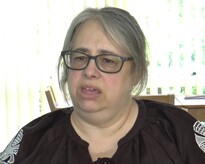
Jackie began to notice her spouse was showing symptoms of dementia when he was 50.
Jackie’s husband has early onset dementia.
More about me...
Jackie began to notice behavioural changes in her spouse when he was 50. She noticed he struggled to understand instructions and began to drive down the wrong side of the road. Jackie, who is professionally knowledgeable about dementia, began to suspect that her spouse was showing signs of the condition. After visiting the doctor, her spouse was diagnosed with Alzheimer’s and placed on medication. However, after getting a second opinion, he was given a new diagnosis of mild cognitive impairment and was taken off his medication. After approaching a colleague for help years later, her spouse was given a scan and diagnosed with Alzheimer’s at age 62.
Jackie’s spouse’s Alzheimer’s has slowly progressed as he is still able to do things independently. However, due to his Alzheimer’s, he is no longer able to work. Since getting his diagnosis, he has gotten involved in dementia-related social groups so he can meet other people with dementia. While Jackie’s spouse enjoys attending these groups, Jackie struggled to find people who understand what it is like to care for someone whose dementia progresses differently.
Jackie’s spouse is bilingual and the progression of his condition has caused him to begin to struggle to speak in English, his second language. Jackie worries that as his linguistic ability in English deteriorates, it will become harder to communicate with him.
Jackie describes having counselling sessions for support.
Jackie describes having counselling sessions for support.
So, I have my own private counsellor as well like a counselling through work when I was off sick. And I actually managed to find her privately and I continued with her and I have occasional sessions with her, which are just supportive and help me deal with some of the emotions that I have around dealing with the situation that that I’m in, ‘cos this was not the plan at all [laughs]. You know, even if you sort of think about dementia in your life, in the future, you don’t think of it when you’re well, how old was I? If he was sixty, I was fifty four. You know, you don’t, you don’t think about.
Jackie talks about complications around diagnoses in a working age person.
Jackie talks about complications around diagnoses in a working age person.
I said, you know, there’s possibility it, it could be something serious or what do you think it might be? I said, “Well, you know, I said, I don’t think it’s anything like a brain tumour because you’ve not got any physical problems.” I said, “But, you know, god forbid that it’s something like, you know, an early dementia or something like that best to get it checked out.” So, he did agree to go to the GP and wanted me to go with him. And when we sat a there and the GP said, “So, why, you know, why are you here [name]?” Well, he just sort of like refused to speak and said, “Ask her.” [Laughs] And the doctor like tried to pursue that with him and he said, “She thinks I’ve got dementia.” The doctor was a bit taken aback and I said, “Well, it’s not exactly what was said.” So, we got to see neurology and they made a diagnosis of Alzheimer’s within 15 minutes without having any scans or anything.
And me being a pharmacist whose special area of interest is dementia, I was like, “Well, that’s not right.” But the situation at home had escalated ever such a lot that when they said that they would put him on Donepezil I was like, well actually let’s just try it and see.” Things improved quite a lot. And, unfortunately, when it came to advising the DVLA and his insurance about the Alzheimer’s [name] decided to get a second opinion. And the second opinion outcome was that he had mild cognitive impairment which I didn’t believe to be true at all that somebody you know, who is, by then he was like 54 having mild cognitive impairment, that is not, you know, I don’t, I didn’t, I wasn’t happy about that diagnosis. But he was very happy because now he didn’t have to tell the insurance.
And, as a consequence of that, he got taken off the Donepezil and things went downhill very very rapidly. And about two years later, we managed to get him back on Donepezil through the GP. But the pharmacist reviewed his records and saw that he didn’t have the official diagnosis of Alzheimer’s and he got taken off it again. Everything went downhill.
So, in February ’19 he had the scan. And in April ’19 he had the diagnosis of Alzheimer’s and he’s got occipital and parietal lesions. And they have a bigger MDT (Multi Disiplinary Team) and they reviewed his two previous scans. So, he had the first scan with neurology when he was 52 and the second one at 54 when he was challenging his diagnosis, asking for a review. And although those MRIs at 52 and 54 they said that there was no issue with them. Once they knew where the lesions were from the PET scan and they examined the MRIs retrospectively they could see that there was a change. So, that was an MDT with old age psychiatry neurology and radiology. And so, yeah, he, he had then a diagnosis of early onset. Well, I think very early onset Alzheimer’s. If I was noticing issues when he was 50 then that is very very early, yeah.
Jackie explains about her partner’s online support groups during Covid-19 pandemic.
Jackie explains about her partner’s online support groups during Covid-19 pandemic.
So, yeah, it was, it was reasonably positive in the pandemic, but he couldn’t get out and do his groups, his group, even. It was just one group, one, one day a week, but it was every week. And they started doing stuff through Zoom and stuff and so he could do it through Zoom. So, he did, he did do that through Zoom. And that was the time that he got involved with [name] Support Group as well. He helped develop. He was heavily involved in developing this dementia care book to support people who’ve got a recent diagnosis of dementia and he was involved remotely and running like ten week courses for people and their carers who’ve had a recent diagnosis of dementia. So, yeah, there’s, there’s quite a positive thing with that. He got a lot out of that. A lot of, it helped with his, you know, self-esteem and confidence and everything.
Jackie talks about insensitive comments from other carers in support groups.
Jackie talks about insensitive comments from other carers in support groups.
I used to go to the men’s group and what would happen is there’s the men and generally their female carers, mainly female carers would go and the female carers would meet in a group and I found it very difficult to find people that I had anything in common with.
And, people do this don’t they and they don’t, they don’t mean anything by it. But they, they would say things like, oh, you know, if I said oh [name] makes, you know, makes me a cup of tea in the morning. Oh God, what I would give if my husband could make me a cup of tea in the morning. You’re so lucky, you know. And [name] used to make cakes and puddings and meals for this dementia group. And, you know, it would be like, [name] made this curry, god, [name] can cook like that, you know. You’re so lucky. You so lucky. It almost sort of like made me feel even worse for feeling bad about my situation because people do that don’t they.
Jackie recalls the first signs of Alzheimer’s in her working age partner.
Jackie recalls the first signs of Alzheimer’s in her working age partner.
And the idea was that [name] would start to run a business, a small catering business. And, so, it became apparent almost immediately that he could not operate this business at all. He was very capable and confident doing the front of house. Even the cooking that, it was a small café, even the cooking, he was fine with that. But the, the planning and the organisation of getting the stock in and having the staff, it was just not very good at all. And things proceeded to deteriorate and he was 50, I would say when I was like there is something really not right.
So, he’d tried to drive the wrong, down the wrong side of the road and the children who were quite young were asking me not to send him to pick them up. He’d driven through red lights and when they’d pointed out to him that it, the light was red, he got exceedingly angry and aggressive to the level that they didn’t feel safe in the car.