
Paul I
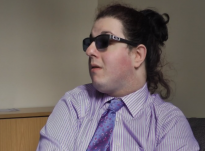
Paul had developmental delay as a child, and was diagnosed with an array personality disorders before he received his autism diagnosis at the age of 21. He is currently working at a support organisation, where he gives talks about life on the autism spectrum.
Ethnic background: White British
More about me...
Paul was born in 1986 due to a difficult birth, jaundice and placental abruption he had severe developmental delays in speech, language and motor coordination his Mum thought he was "deaf and blind" as a child and considered him to be solely brain damaged.
Paul was branded as a “naughty child” at school. He was classically autistic in his early years and gained functional speech around the age of 7 or 8 years old. He went through mainstream school with no additional help or recognition of his autism. Consequently, he did not achieve his academic or his social potential and had very low self-esteem.
After a string of unsuccessful jobs, Paul’s mental health suffered. He was referred to mental health services and misdiagnosed with “Asperger traits with a complex personality” which did not satisfy him. Paul was later diagnosed by an experienced psychiatrist, who diagnosed him with High Functioning Autism at 24 years old.
Paul wanted to promote autism awareness and help others on the autism spectrum, in the hope that others would not have to suffer as he had. He became a speaker for an autism organisation and has not looked back.
Presenting speeches, training and conducting consultancy, Paul is now freelance and continues to raise the profile of autism at every opportunity. Having done a lot of research, he is keen to explain the differences between Asperger’s Syndrome & Autism and show that autism is not "one thing" using Autism Consultant Donna William's (Polly Samuel's) ‘Fruit Salad’ model.
Paul firmly believes in retaining the ASD (Autism Spectrum Disorder) acronym. He says there should not be a negative stigma around the word ‘disorder’. His message is that Autism is a complex mix of ability and disability and every person with autism (and all people) should be a valued member of society.
Currently Paul not only does freelance autism work but also works as an in-house autism consultant for a small autism organisation. In his free time, he enjoys writing poetry, drawing, going for walks and going out with friends.
Paul I’s mum thought he was “deaf and blind” initially because of the way he interacted with the environment.
Paul I’s mum thought he was “deaf and blind” initially because of the way he interacted with the environment.
One lady asked me "How did it feel, not to have speech?" And I said "For me, personally for me, because I can only talk from my own perspective, you imagine the deepest part of the ocean. And the words are at the bottom of the sea bed. And that was the struggle, to get all these words that were fragmented in my mind."
One of Paul I’s friends unfriended him on Facebook when he didn’t recognise her face.
One of Paul I’s friends unfriended him on Facebook when he didn’t recognise her face.
And she said "Hello Paul, how are you?" And I was, I looked at her, and there was, you know, tumbleweed sort of going along. Awkward silence. And I said, just said "Who are you?" Probably not the best way to say it. And she said "I'm so and so." I said "I don't know who you are, can you give me a bit more information to make it relevant and contextual?" And she said "Oh yeah, I'm [Name] from haematology, I'm the matron."
Then it clicked. And there have been moments where I think I've unintentionally been too brisk, brusque rather, with people. I remember I was in [Supermarket name] and a lady said "Hello, Paul." And I said "Hello." And I tracked her, and she actually unfriended me on Facebook. But I understand why, because I just went up to her and I said "I'm sorry, but who are you?" You know? It was just, I knew the mistake I made. It was the way I used my voice, and I think it kind of, it kind of… I think it scared her. Because I just… it was too, it was almost interrogative, rather than "So, who are you?" I think if I could have gone back, and then, you know, next day I was unfriended. I think I understand why. I think it just, it just offended her. And that is going to happen.
Paul I sees himself as Paul first; “a human like everyone else”.
Paul I sees himself as Paul first; “a human like everyone else”.
That's a good…yeah. Do I see? I don't see myself purely as autistic, no. I see myself as Paul, first. A human like anyone else. Seven billion people on this planet. If you just gave every one a bloody label, you know, where's the person? You know? You can, you can put… you can slap a load of labels on, you know, Branston Pickle, but you really want to know what's inside the Branston Pickle, don't you. You want to experience it. A label is just a marker. It is a gateway. It's not necessarily a definition. So if you're asking me if I'm identity first, no I'm not. And I know that will annoy… sorry, people who are. Because I know that, I know it annoys some people, some people on the spectrum. But I've had so… just please, people who are going to be watching this, if you listen to my early years, I struggled to find the person. So I think in, at least in Paul's reality, hopefully you'll understand why I want to be seen as a person first, because I struggled to get there. Because of all the kaleidoscopic difficulties I had. And even having a sense of self was hard to acquire, because of those things.
Paul I lives at home with his parents and is glad they don’t “baby or mollycoddle” him.
Paul I lives at home with his parents and is glad they don’t “baby or mollycoddle” him.
When Paul I was seven, he started dissociating at school.
When Paul I was seven, he started dissociating at school.
What do you mean by associating?
Dissociating.
Can you explain what you mean by that?
Well, it's a mental health condition where you take yourself away. I mean normal dissociation is what we all do, day-dreaming. And that can last for minutes and then you're back in the room. But what I was doing was slowly that was becoming more than minutes. That was becoming, you know, five minutes, ten minutes, hours. Just completely shutting off, as a way of coping with - I suppose in some ways, a perceived trauma, of…of being, you know, just constantly criticised. But one learns. And that, I don't feel sorry for myself, and I don't consider myself a victim, it just happened. And the only way one can learn from things is by understanding what went wrong, and then trying to make amends to it. So - and that's for any child, it's not just a child with a disability. Any child. You wouldn't do that to any child. And if you can learn from that, you know, 'is this really okay? Is this boy going to remember this in twenty years’ time, and talk about it? What can we learn about it?'
So, from that perspective - I don't think they were trying to harm me. I don't even think they were trying to bully me. I just think they're trying to understand me.
Paul I developed somatization disorder in Year 7.
Paul I developed somatization disorder in Year 7.
Paul began his career as an autism consultant working at an autism organisation for five years.
Paul began his career as an autism consultant working at an autism organisation for five years.
And I connected with Donna Williams on Facebook about a year later, from her speech, so it was about 2010. And I started looking at some of the videos about processing, language, etc. And then I saw this image of the fruit salad, where she puts different things into different domains. So information processing, personality, mental health, learning and environment. And then it started got me thinking, autism isn't one thing, is it? And she said "No. It's a clustering of different things." So then I started building up my own fruit salad, so I could contextualise each piece when I speak. And that's what I've done.
